SOUL SPECTRUM / FIELD NOTES
Undertale Soul Traits Meaning, Explained
Written by Rowan · Last verified: September 14, 2026
Undertale gives you seven human soul colors and six trait words — and remarkably little else. Everything the fandom “knows” about the seven souls rests on a handful of in-game clues, so this explainer separates what the game actually establishes from what a decade of fan interpretation built on top. The short answer first:
7 SOUL COLORS6 CANON TRAIT NAMES1 FAN CONVENTION (RED)6 ITEM SETS3 EVIDENCE SOURCESCANON VS. FANON, LABELED
Take the free test ↗Jump to the canon evidence ↓
| Soul color | Trait | Canon status | Items left behind |
|---|---|---|---|
| Red | “Determination” | Fan convention — the trait is never named in the game | Stick + Bandage; Worn Dagger + Heart Locket |
| Light blue (cyan) | Patience | Named in the Ball Game | Toy Knife + Faded Ribbon |
| Orange | Bravery | Named in the Ball Game | Tough Glove + Manly Bandanna |
| Blue | Integrity | Named in the Ball Game | Ballet Shoes + Old Tutu |
| Purple | Perseverance | Named in the Ball Game | Torn Notebook + Cloudy Glasses |
| Green | Kindness | Named in the Ball Game | Burnt Pan + Stained Apron |
| Yellow | Justice | Named in the Ball Game | Empty Gun + Cowboy Hat |
Bottom line: six of the seven pairings come from a single minigame screen and can be treated as canon-backed. The red soul’s “Determination” label is fandom convention — the game never names it. Everything below traces how far that small foundation actually carries.
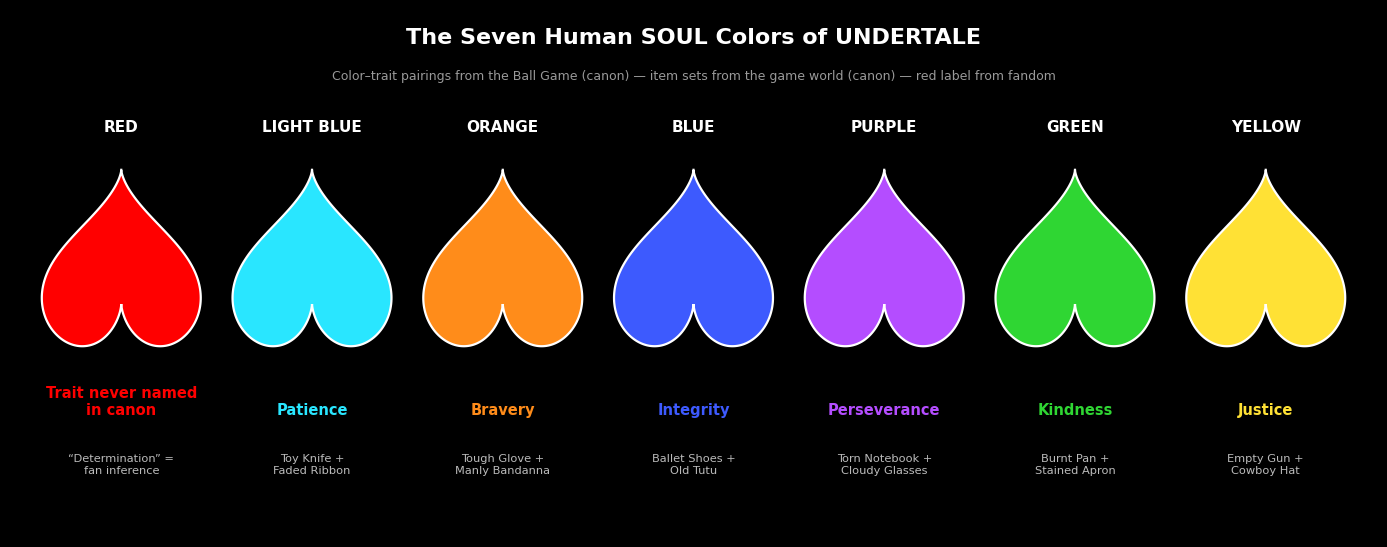
What canon establishes for each soul
The entire trait system traces back to one optional minigame: the Ball Game in Snowdin. Win the red flag for the first time and the game prints “Bravery. Justice. Integrity. Kindness. Perseverance. Patience.” — each word displayed in the color of one of the six collected souls. That single screen is the only place in Undertale where the traits are named, which is why the six color-trait pairings can be treated as canon-backed even though the game never writes the sentence out as a rule (Undertale Wiki, Ball Game).
The red soul is the exception. Nowhere in the game, the manual or any developer statement is it assigned a trait word. On repeat red-flag wins, the game offers a different message instead: “Try as you might, you continue to be yourself.” Fans read that as pointing to identity or player agency rather than Determination — one reason the red-equals-Determination label stays a convention, not a fact.
Beyond the six words, each colored flag adds a short behavioral sketch — as close to canon personality as the souls get:
- Patience — you “waited, still, for this opportunity” before a sharp attack.
- Bravery — “the kind of person who rushes fists-first through all obstacles.”
- Integrity — “hopping and twirling, your original style pulled you through.”
- Perseverance — “even when you felt trapped, you took notes.”
- Kindness — “your concern and care” led to “a delicious victory.”
- Justice — “sure-fire accuracy” ended the mayhem.
Each color also maps to a battle mechanic: cyan attacks only hurt a moving soul, orange attacks only hurt a stationary one, blue mode adds gravity, green mode turns the soul into a shield, purple mode restricts movement to lines, and yellow mode lets the soul shoot. Canon tells you what each soul does in a fight — never what kind of child carried it.
See how each trait becomes an everyday reflection prompt on our seven soul virtue pages ↗.
The in-game evidence trail
Spoiler care: this section mentions areas and scenes from late in a first playthrough, including New Home and the Neutral Route finale.
The trail starts with the Ball Game itself. Each of its seven colored flags carries a short narrator comment — the closest thing to canon personality sketches the souls have:
| Flag | Exact canon text | Reward |
|---|---|---|
| Light blue | “You waited, still, for this opportunity... then dethroned ‘Ball’ with a sharp attack.” | 4G |
| Orange | “You are the kind of person who rushes fists-first through all obstacles.” | 5G |
| Blue | “Hopping and twirling, your original style pulled you through.” | 2G |
| Purple | “Even when you felt trapped, you took notes and achieved the end of ‘Ball.’” | 2G |
| Green | “Your concern and care for ‘Ball’ led you to a delicious victory.” | 1G |
| Yellow | “Your sure-fire accuracy put an end to the mayhem of ‘Ball.’” | 3G |
| Red (first win) | “Bravery. Justice. Integrity. Kindness. Perseverance. Patience. Using these, you were able to win at ‘Ball Game.’” | 50G |
| Red (repeat) | “Try as you might, you continue to be yourself.” | 10G |
Bottom line: the flags describe the player’s own behavior in the minigame, not the fallen children. And the “best” red flag is earned by showing all six traits at once — the game’s sly hint that red is the synthesis, not a seventh virtue.
Three more clues let fans match the six souls to six individual children. First, the colored coffins: the basement of New Home holds seven coffins, each marked with a heart in its occupant’s soul color — the in-world proof that every colored soul belonged to one person who lived, traveled and died. Second, the item sets: six matched weapon-and-armor pairs are scattered along the game’s path, from the Toy Knife and Faded Ribbon in the Ruins to the Empty Gun and Cowboy Hat recovered in Hotland, and their flavor texts quietly imply hobbies — ballet, cooking, note-taking, play-acted toughness. Third, the Omega Flowey fight: each captured soul attacks with its signature items, then heals you when called upon (Undertale Wiki, Eight humans).
What the trail never provides is just as important: no canon names, genders, falling order or causes of death for the six children. The game leaves each child’s ending unwritten — deliberately, it seems.
Canon vs. fan interpretation — clearly marked
Here is the honest line. Canon provides six trait words, seven colors, six item sets, and one statement that the children “were all different people with their own personalities.” Everything else is fanon. The ballerina blue soul, the sheriff yellow soul, fixed names and designs, the order the children fell, how each one died — all creative readings, many traceable to fan works rather than the game. The pink soul of Fear, trait inversion and HATE come from the fan animation Glitchtale. Clover, the yellow-souled child with a face and a name, belongs to the fan prequel Undertale Yellow.
Our quiz sits in that fan-built tradition, and we would rather say so than dress it up as lore. The virtue profiles on this site — Determination as commitment, Patience as composure, Integrity as honesty — are fan elaboration anchored in the flag texts and item sets, not official canon or validated psychology. Transparency about that is the site’s methodology stance, described in full on the methodology page.
Determination’s special role
Spoiler care: this section discusses the True Lab and late-game routes, including Flowey, Asriel, Undyne and the Amalgamates.
In canon, Determination is not a personality trait at all — it is a substance present in every human soul. Alphys defines it in the True Lab as “the will to keep living... the resolve to change fate,” extracted from all six collected souls. That is the strongest canon argument against “red = Determination”: if every human soul contains it, it cannot be the red soul’s distinguishing trait (Undertale Wiki, Determination).
Mechanically, determination runs the story. The being with the most of it in the underground controls SAVE and LOAD — which is why Flowey, a flower injected with determination but no soul, could reset timelines until Frisk arrived and out-determined him. It is why Undyne, the one monster with natural determination, can refuse death while her body melts. And it is why the Amalgamates — fallen-down monsters given extracted determination — fused into beings that cannot be killed in battle at all. At the Asriel climax, the protagonist’s soul shatters and “it refused”: determination as literal player agency.
Soul extractor: the quiz or the machine?
Searching for an Undertale soul extractor can lead to two different things: a fan-made personality quiz, or the DT Extraction Machine in the True Lab. The in-game machine is part of the determination experiments described above; it is not a personality test. Soul Spectrum uses “extractor” as a name for its questionnaire. You answer everyday statements to explore seven fan-inspired traits, without needing to know the story.
How our quiz maps the seven traits
Soul Spectrum keeps the fandom’s familiar seven-label set — Determination plus the six canon-named virtues — and builds each scale from original, everyday-behavior statements rather than lore trivia. Determination, Kindness and Perseverance carry ten items each; Bravery, Justice, Patience and Integrity carry nine, split evenly between direct and reverse-scored statements. Every virtue is scored 0–100 with 50 as the neutral midpoint, and the full arithmetic is public on the methodology page. For reading your leading pair, close leaders and balanced results, see how to read your result.
Frequently asked questions
What are the seven soul colors in Undertale?
Red, light blue, orange, blue, purple, green and yellow. The Ball Game in Snowdin pairs six of them with traits — Patience, Bravery, Integrity, Perseverance, Kindness and Justice. The red soul’s trait is never named in the game; fans conventionally call it Determination.
Is the red soul really Determination?
It is a near-universal fan convention, not a canon label. The game never names the red soul’s trait, and its own red flag text says “Try as you might, you continue to be yourself.” Because determination is found in every human soul, some fans argue red stands for identity instead. Quizzes like ours use the conventional label and say so openly.
Are these trait profiles official?
No. The virtue profiles on this site — and on every “which Undertale soul are you” quiz — are fan interpretation built on six words from one minigame. Undertale names the traits once and never profiles the children. We anchor our profiles in the canon flag texts and item sets, and label everything beyond them as fanon rather than presenting it as lore.
Is Soul Spectrum affiliated with Undertale or Toby Fox?
No. This is an independent, fan-made project with no affiliation or endorsement from Toby Fox, UNDERTALE, DELTARUNE or Jaden’s original test. Those names belong to their respective owners; our questions, scoring and interpretations are entirely our own.
Where does Undertale actually name the six traits?
Only in one place: the optional Ball Game in Snowdin. Earning the red flag for the first time prints “Bravery. Justice. Integrity. Kindness. Perseverance. Patience.” with each word shown in a matching soul color. Every trait-color pairing in the fandom traces back to that single screen.
Which Undertale soul are you?
The game never says — it leaves the fallen children as colored silhouettes, so there is no canon answer to match you to. Fan quizzes like ours answer the question differently: 66 statements about everyday behavior, scored across the seven familiar labels, as a reflection exercise rather than a lore verdict.
Did the game confirm each fallen child’s personality?
No. Undertale never shows the six children’s names, genders, journeys or deaths. The closest thing to canon characterization is a line added for the 10th Anniversary Stream: the fallen humans “were all different people with their own personalities” — deliberately without assigning any trait to any color.
Is the pink soul of Fear canon?
No. The pink Fear soul, trait inversion and HATE come from Glitchtale, a fan animated series, and the wider alternate-universe scene. Undertale itself never mentions additional soul colors or inverted traits.
Who is Clover, the yellow-souled child?
Clover is the protagonist of Undertale Yellow, a fan-made prequel released in 2023 with Toby Fox’s informal blessing. The game imagines the Justice soul’s journey, but Clover’s name, design and story belong to that fan work, not to Undertale.
What items did each soul leave behind?
Patience: Toy Knife and Faded Ribbon. Bravery: Tough Glove and Manly Bandanna. Integrity: Ballet Shoes and Old Tutu. Perseverance: Torn Notebook and Cloudy Glasses. Kindness: Burnt Pan and Stained Apron. Justice: Empty Gun and Cowboy Hat. The red souls are linked to the Stick and Bandage, and the Worn Dagger and Heart Locket.
Do the soul traits appear in Deltarune?
Yes, in spirit. Deltarune Chapter 5’s 7 Colored Flowers are characters named and characterized after the same color-trait pairs — the first time a Toby Fox work embodies the traits as personalities. It treats the Ball Game’s mapping as settled without changing Undertale’s own story.
Related pages
- The seven soul virtues — meanings and strengths
- How your soul spectrum is calculated
- How to read your soul test results
- About Soul Spectrum
- UNDERTALE — the official site ↗
READY WHEN YOU ARE
Find your own soul spectrum
- ✓ 66 original questions, about ten quiet minutes
- ✓ All seven scores and the full interpretation, free
- ✓ No account — answers stay in your browser
Not ready to answer 66 questions?
- ✓ Read the public scoring formula first
- ✓ See what a result does — and does not — say
- ✓ Check how we separate canon from fanon